
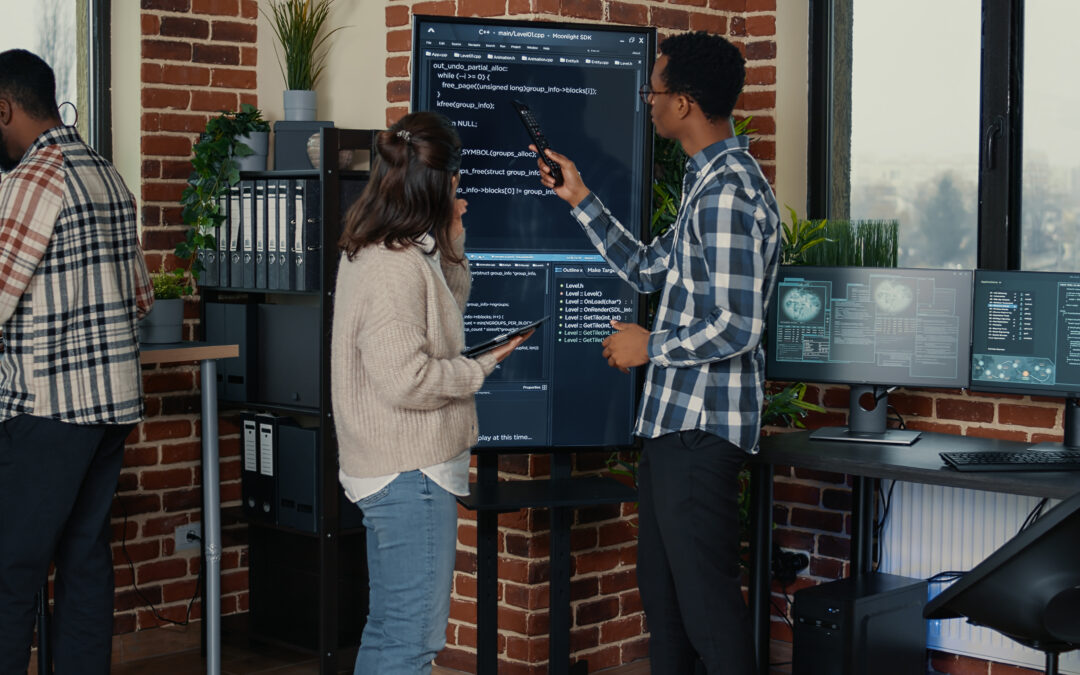
Software development continues to accelerate, and 2026 promises even more transformation in coding workflows. In a world of rapid evolution of AI, low-code/no-code platforms, cloud-native architecture, and next-generation programming tools, developers will need to modernize to keep pace.
This blog explores the trends, emerging tools, and key expectations for coding in 2026.
1. AI Will Become an Integral Development Partner
By 2026, AI won’t just assist coding—it will actively shape it. Generative AI, like GitHub Copilot, OpenAI Codex, and similar tools, will be far more intelligent.
Key capabilities:
- Full Module Creation: Entire application modules built using high-level prompts.
- Contextual Understanding: AI will understand business logic, user workflows, and cross-platform dependencies.
- Error Prediction and Prevention: Proactively warn about design flaws, security vulnerabilities, and performance bottlenecks.
Impact: Developers will spend less time on boilerplate code and debugging, freeing more time for architecture, strategy, and complex problem-solving.
2. Low-Code and No-Code Will Go Mainstream
Low-code and no-code platforms are growing, and by 2026, they will be enterprise-ready and AI-augmented.
Capabilities:
- Rapid application prototyping with minimal coding.
- AI suggests workflows, UI components, and back-end logic.
- Non-developers can contribute to product creation, reducing bottlenecks.
Impact: Democratization of software development, enabling business teams to contribute directly without compromising quality.
3. Multi-Platform Development Becomes Seamless
Demand for apps to run on web, mobile, and cloud platforms will drive the evolution of coding tools.
Capabilities:
- AI-assisted frameworks automatically adapt code across environments.
- Complex dependencies handled automatically by cross-platform libraries.
- Real-time testing and optimization across devices and operating systems.
Impact: Write once, deploy everywhere, significantly reducing time-to-market.
4. Cloud-Native and Serverless Architectures Dominate
Cloud-native coding practices will be the default by 2026.
Features:
- Serverless and microservices architectures.
- AI + Infrastructure as Code (IaC) for provisioning, scaling, and monitoring.
- Event-driven programming and reactive systems.
Outcome: Modular, scalable, and resilient code enabling rapid iteration and easy maintenance.
5. Advanced Automation of Testing and Deployment
Automation will extend beyond CI/CD pipelines.
Capabilities:
- AI-driven testing simulates real-world user behavior and predicts edge-case failures.
- Automated deployment bots adapt to differing cloud environments in real time.
- Predictive rollback and recovery mechanisms reduce faults and downtime.
Impact: Software releases become safer, faster, and more reliable.
6. Emphasis on Secure and Ethical Coding
With AI-generated and collaborative coding, security and ethics will be central.
Capabilities:
- AI detects vulnerabilities during development.
- Compliance automation ensures adherence to regulations like GDPR, CCPA, HIPAA.
- Developers are responsible for ethical coding practices, especially in AI applications.
Impact: Proactive security reduces breaches and strengthens user trust.
7. Developer Roles Will Evolve
Coding jobs will shift from repetitive coding to designing intelligent systems.
New responsibilities:
- Architects and strategists define workflows, AI interactions, and multi-system integrations.
- Programmers oversee AI-generated code for quality and maintainability.
- Cross-disciplinary skills in AI literacy, cloud operations, and UX are required.
Impact: Developer roles blend engineering, creativity, and decision-making.
8. What to Expect in Tools and Languages
Emerging trends:
- AI-Enhanced IDEs: Real-time suggestions, predictive debugging, and cross-platform adaptation.
- Next-Gen Languages: Optimized for concurrency, distributed systems, and AI integration.
- Integrated Analytics: IDEs providing instant feedback on performance, security, and scalability.
- Collaboration Environments: Cloud-based, real-time coding for global teams.
Impact: Developers will work in smarter, more interactive coding environments.
9. Conclusion
Coding in 2026 will revolve around productivity, intelligence, and collaboration. AI will act as a true development partner, low-code/no-code platforms will empower non-developers, and cloud-native architectures will dominate. Security, ethics, and user-centric design will be integrated from the start, while cross-platform deployment and automation will accelerate software delivery.
Key insight: Developers who thrive will leverage AI, automation, and cloud-native practices while focusing on strategy, innovation, and complex problem-solving rather than just writing code.